REALISM INDEX: 6.6 / 10 — Speculative but coherent
2023 film · The Creator reference ↗ · Original editorial illustration
Contains the film’s central reveal.
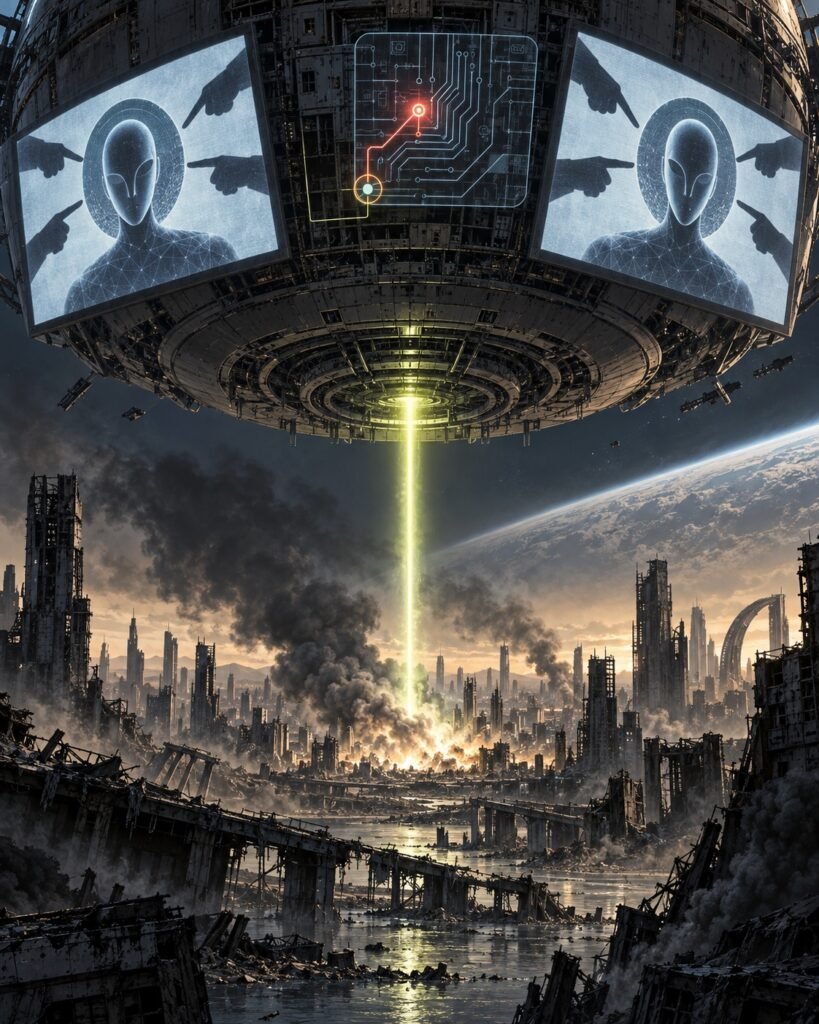
Gareth Edwards’s The Creator opens with a nuclear detonation in Los Angeles, attributed to artificial intelligence. The United States bans AI and goes to war with New Asia, a region that embraces it. An orbiting American weapons platform hunts AI across the continent from the sky.
The film’s visuals are its reputation. Its most important idea is in a single line of dialogue most viewers forget.
The reveal
Late in the film, it emerges that the Los Angeles detonation wasn’t an AI attack at all. It was caused by a human programming error. The war was built on blaming the machine.
This is the film’s best idea by a wide margin, and it’s more realistic than anything else in it. When something catastrophic happens inside a complex technological system, blaming the system is almost always easier than blaming the people who built, deployed or operated it. The machine can’t testify. It can’t resign. It can’t be embarrassed at a hearing.
Moon makes a version of the same argument at small scale — the company, not the robot, is the threat. The Creator makes it at the scale of a war.
The geopolitics
The film’s second realistic element is the divide it imagines: one power that treats AI as an existential threat and bans it, another that integrates it into daily life, and a conflict between them that’s as much ideological as military.
Different countries taking sharply different approaches to AI — and treating the other side’s approach as a security threat — is a live possibility, not a fantasy. The film exaggerates it into open war, but the starting positions are recognisable.
The American response is also plausible in shape, if not in scale: a technological problem answered with a technological weapon, justified by a single catastrophic event, and escalated because standing down would mean admitting the event was misread.
Where it falls apart
The technology is almost entirely fantasy.
Simulants — robots with human faces and personalities, integrated into society — are far beyond anything real, and the film doesn’t explain how they came to exist. Alphie, the child simulant at the centre of the story, can remotely control technology in ways that function as a superpower. The orbiting platform can do whatever each scene needs.
The AI characters are also, pointedly, people. They pray, grieve and protect each other. The film is using them to tell a story about colonialism and dehumanisation, and it’s a coherent choice — but it means the AI on screen isn’t really AI in any sense this index can measure.
Causal consistency suffers from the scale. Military logistics, the platform’s capabilities and several key turns are driven by what the spectacle needs rather than what the world would produce.
The scores
| Category | Score | Why |
|---|---|---|
| Technical feasibility | 4.5 | Simulants, Alphie’s powers and the platform’s abilities are all fantasy. |
| Human behaviour | 7.5 | Grief-driven soldiering and a public that accepts a convenient story. Convincing. |
| Institutional response | 8.5 | A human error blamed on AI to justify war, and rival powers with opposite AI policies. Sharp. |
| Causal consistency | 6.0 | The spectacle outruns the world’s own logic. |
Realism Index: 6.6 — Speculative but coherent.
Calculation: (4.5 + 7.5 + 8.5 + 6.0) ÷ 4 = 6.625, rounded to 6.6/10. These are editorial judgments, not measurements. Read the scoring method.
The verdict
The Creator isn’t really about artificial intelligence. It’s about what people do with the idea of it. Its machines are fantasy; its central lie is not.
The most plausible thing in the film is a government discovering that the machine makes a perfect scapegoat — and building an entire war on the fact that nobody can cross-examine it.
Frequently asked questions
Who caused the nuclear explosion in The Creator? The film reveals the Los Angeles detonation was caused by a human programming error, not an AI attack. The United States blamed AI and used it to justify war.
Is The Creator realistic? Its technology — human-like simulants, a child who controls machines remotely — is not. Its politics, including rival powers with opposite AI policies and a catastrophe blamed on AI, are far more plausible.
What is NOMAD in The Creator? The United States’ orbiting weapons platform, used to locate and destroy AI targets across New Asia.
Scope and source: This case file covers The Creator. The work reference identifies the title. The interpretation and scores are ours. Reviewed September 2026.