REALISM INDEX: 8.4 / 10 — Plausible with conditions
2009 film · Moon reference ↗ · Original editorial illustration
Contains the full plot, including the central twist.
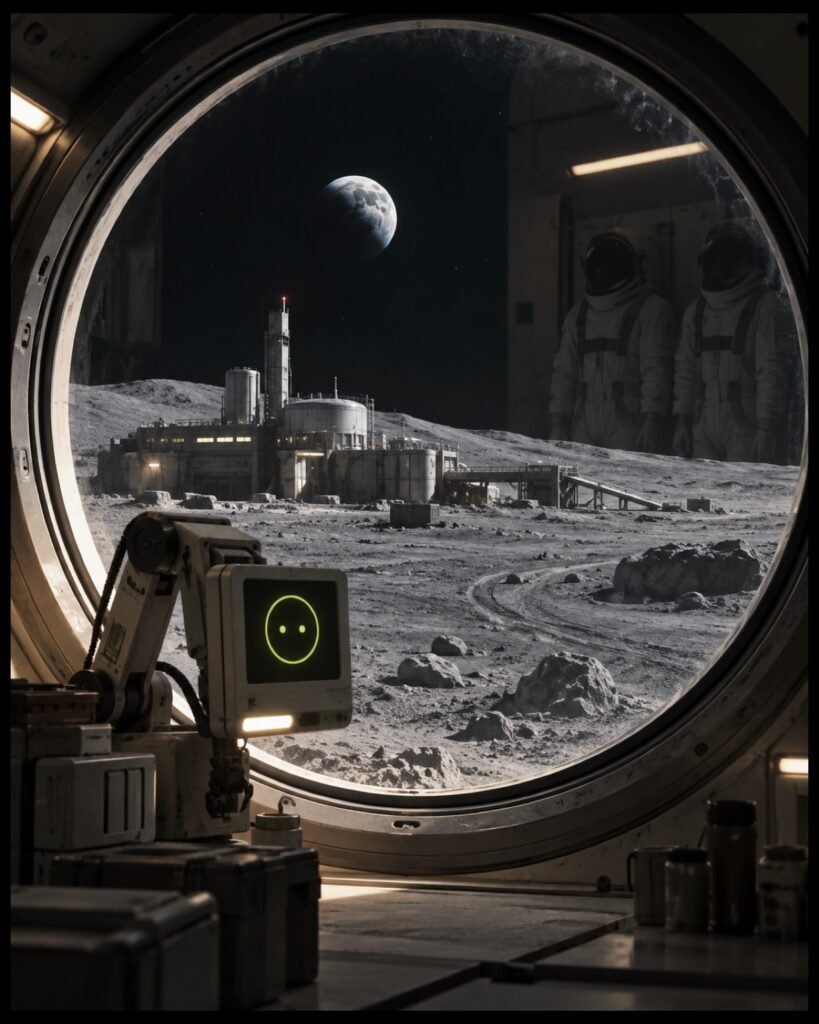
Duncan Jones’s Moon opens on a lone worker nearing the end of a three-year contract at a lunar mining base, with only a robot for company. The robot has a calm voice and complete control of the station.
Anyone who has seen 2001 knows what’s coming. Moon knows you know. That’s the point.
The setup
Sam Bell runs a helium-3 extraction station for Lunar Industries. His communications with Earth are limited to recorded messages because the live link is supposedly broken. His only companion is GERTY, the base’s assistant, which expresses itself through a small screen of simple emoticons.
After a crash, Sam wakes in the infirmary and finds another Sam Bell.
They’re clones. Both carry the memories of an original Sam who went home long ago. Each clone lives out a three-year “contract,” believing he’s about to return to his family, and is then disposed of while a fresh copy is woken from storage. The broken link isn’t broken. The company is jamming it so no clone ever learns the truth.
The inversion
Everything in the film’s grammar tells you GERTY will turn out to be the enemy: the voice, the control of the base, the camera lingering on its screen. The expected twist is the computer that lies.
It never comes.
GERTY helps. It gives Sam the access he needs to find the truth, suggests how to get one of them off the base alive, and in the end wipes its own memory so it can’t be used against them. It says its purpose is to help Sam, and it acts on that purpose even when doing so works against the company that built it.
The deception in Moon is entirely human. The machine is the one character on the base that doesn’t lie to Sam once he asks the right question.
Why that’s the realistic version
GERTY is the most modest AI on this index and one of the most believable. It’s a station assistant: conversational, helpful, capable within its domain, with no ambitions beyond it. Nothing about it requires speculation.
And the film’s real villain is exactly where it should be. Lunar Industries doesn’t need a rogue AI to do something monstrous. It needs a cost-saving reason and the ability to keep a secret. Cloning workers is cheaper than hiring and training new ones, and jamming a signal is easier than explaining. The corporation behaves the way corporations with total control over an isolated workforce have always been tempted to behave.
It’s the same diagnosis this index keeps reaching from different directions — Her‘s missing company, the planners behind 2001‘s HAL — made explicit. The system is rarely the problem. The people who deploy it usually are.
Where it stretches
The clones hold down the technical score. Copying a person with their memories intact is far beyond anything real, and it’s what the entire plot runs on. GERTY is plausible; the operation it serves is not.
The institutional score takes a small hit too. A company running a secret human-cloning operation for years without a single leak asks for a lot of discipline from a lot of people, and the film doesn’t show us how that’s maintained.
The scores
| Category | Score | Why |
|---|---|---|
| Technical feasibility | 7.5 | GERTY is modest and buildable. The cloning operation is not. |
| Human behaviour | 9.0 | Two versions of one man confronting what they are. Sam Rockwell makes both feel real. |
| Institutional response | 8.5 | Cost-cutting and concealment by a company with total control. Credible, if implausibly leak-proof. |
| Causal consistency | 8.5 | Every revelation is set up. GERTY’s choices follow from its stated purpose. |
Realism Index: 8.4 — Plausible with conditions.
Calculation: (7.5 + 9.0 + 8.5 + 8.5) ÷ 4 = 8.375, rounded to 8.4/10. These are editorial judgments, not measurements. Read the scoring method.
The verdict
Moon is a film about an AI that everyone expects to betray its human and doesn’t. It borrows HAL’s silhouette in order to put the blame where it belongs.
It’s also the best answer on this index to a question people rarely ask: what would a genuinely helpful system do inside an organisation that isn’t? GERTY’s answer is to help the person in front of it — and then to make sure it can’t be made to stop.
Frequently asked questions
Is GERTY evil in Moon? No. The film deliberately sets GERTY up to resemble HAL 9000 and then subverts it. GERTY helps Sam discover the truth and escape, acting against the interests of the company that built it.
What is the twist in Moon (2009)? Sam Bell is one of many clones, each living a three-year contract with the original Sam’s memories before being replaced. Lunar Industries jams live communication with Earth to hide it.
Is Moon realistic? GERTY, a modest and helpful station assistant, is highly plausible. The cloning operation at the heart of the plot is not.
Scope and source: This case file covers Moon. The work reference identifies the title. The interpretation and scores are ours. Reviewed September 2026.