REALISM INDEX: 7.6 / 10 — Plausible with conditions
2012 Anime TV series · Psycho-Pass on IMDb ↗ · Original editorial illustration
Contains the major reveal of season one.
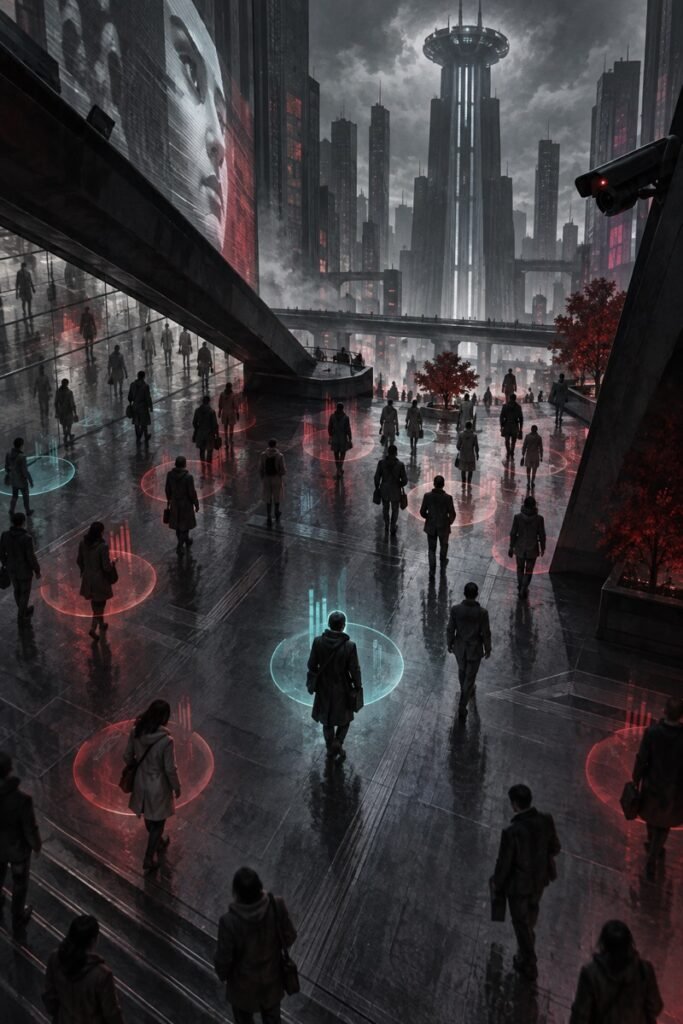
In Psycho-Pass, a system called Sibyl continuously scans every citizen’s mental state and assigns a number. Cross the threshold and you are a latent criminal — detained, treated, or, if the number climbs high enough, killed on the spot by a gun that decides for itself whether to fire.
The technology is the weakest part of the show. What it gets right is everything around the technology.
The score that changes behaviour
Sibyl’s scanner is fantasy. There is no reading of criminal intent from a street-level scan of someone’s psychological state, and no demonstrated way to do so.
But watch what the citizens do. They monitor their own hue the way people now monitor steps and sleep. They take supplements, book therapy, avoid upsetting films, and steer clear of friends whose numbers are clouding, because proximity to stress is itself a risk. Nobody is forced to do most of this. The score makes self-management the rational choice, and the population polices its own inner life at no cost to the state.
That is the real mechanism of scored societies, and the show understood it early. The most powerful effect of a risk score isn’t the punishment at the threshold. It’s everything people do to stay well clear of the threshold.
The gun that won’t fire
The Dominator only fires when Sibyl authorises it. The officer points; the system decides. This is presented as a safeguard, and in one sense it is — no officer can shoot someone the system judges harmless.
It’s also a way of dissolving responsibility. When the gun kills, no one pulled the trigger in any sense that matters. The inspector was holding it. Sibyl made the call. The institution gets lethal force with nobody accountable for its use.
This is the show’s most precise institutional insight. Automated decisions aren’t dangerous mainly because machines are cruel. They’re dangerous because they let human organisations do things that no individual in them would sign their name to.
The man the system can’t see
Makishima is criminally asymptomatic. He can commit murder with his hue perfectly clear, and when a Dominator is pointed at him it simply declines to engage.
The show treats this as a supernatural exception. It’s actually the most ordinary failure of any scoring system: it measures a proxy, and anyone whose behaviour and proxy come apart becomes invisible to it. The system is not only blind to such people — it actively certifies them as safe.
The reveal
Sibyl is not a machine. It is a networked collective of human brains, drawn from people who, like Makishima, the system could never measure. The impartial algorithm that governs Japan is a committee hiding inside a server room.
Taken literally, this is the show’s biggest stretch, and it costs points on consistency. Why the people least legible to the system would be best suited to run it is asserted more than explained.
Taken as a metaphor, it’s the sharpest thing in the series. Automated systems are routinely presented as neutral while encoding the judgement of the specific people who built, tuned, and supervise them. Sibyl’s legitimacy depends entirely on the public believing there is no one inside. The show’s point is that there always is.
The scores
| Category | Score | Why |
|---|---|---|
| Technical feasibility | 5.0 | Reading criminal intent from a mental-state scan is not possible and isn’t close. |
| Human behaviour | 9.5 | Citizens managing their own scores is the most accurate depiction of scored life in fiction. |
| Institutional response | 9.0 | The Dominator dissolves accountability exactly as automated decisions do. |
| Causal consistency | 7.0 | The brain-network reveal works thematically and strains mechanically. |
Realism Index: 7.6 — Plausible with conditions.
Calculation: (5.0 + 9.5 + 9.0 + 7.0) ÷ 4 = 7.625, rounded to 7.6/10. These are editorial judgments, not measurements. Read the scoring method.
The verdict
Psycho-Pass gets the machine wrong and the society right. No scanner will ever read a clouded hue. But a population that edits its own feelings to keep a number low, an institution that lets a gun decide so nobody has to, and a supposedly neutral system with people concealed inside — those require no invention at all.
Frequently asked questions
What is the Sibyl System?
The system in Psycho-Pass that continuously evaluates citizens’ mental states, assigns a Crime Coefficient, and authorises enforcement. Season one reveals it is a network of human brains rather than an artificial intelligence.
Is Psycho-Pass realistic?
Its scanning technology is not. Its depiction of how people behave under continuous scoring, and how automated decisions remove individual accountability, is highly realistic.
Why can’t the Dominator fire at Makishima?
He is criminally asymptomatic — his measured mental state stays clear regardless of his actions, so the system classifies him as harmless.
Scope and sources: This review covers Psycho-Pass. The work listing identifies the title; U.S. Department of Justice report on AI in criminal justice provides context for real-world AI risks. The interpretation and scores are ours. Reviewed September 2026.