REALISM INDEX: 7.6 / 10 — Plausible with conditions
2025 TV series · Murderbot on IMDb ↗ · Original editorial illustration
Covers season one (2025). Contains plot details.
Apple TV’s Murderbot, adapted by Paul and Chris Weitz from Martha Wells’s novella All Systems Red, stars Alexander Skarsgård as a security unit — a SecUnit, part machine and part organic — leased by a corporation to protect a team of scientists surveying a planet.
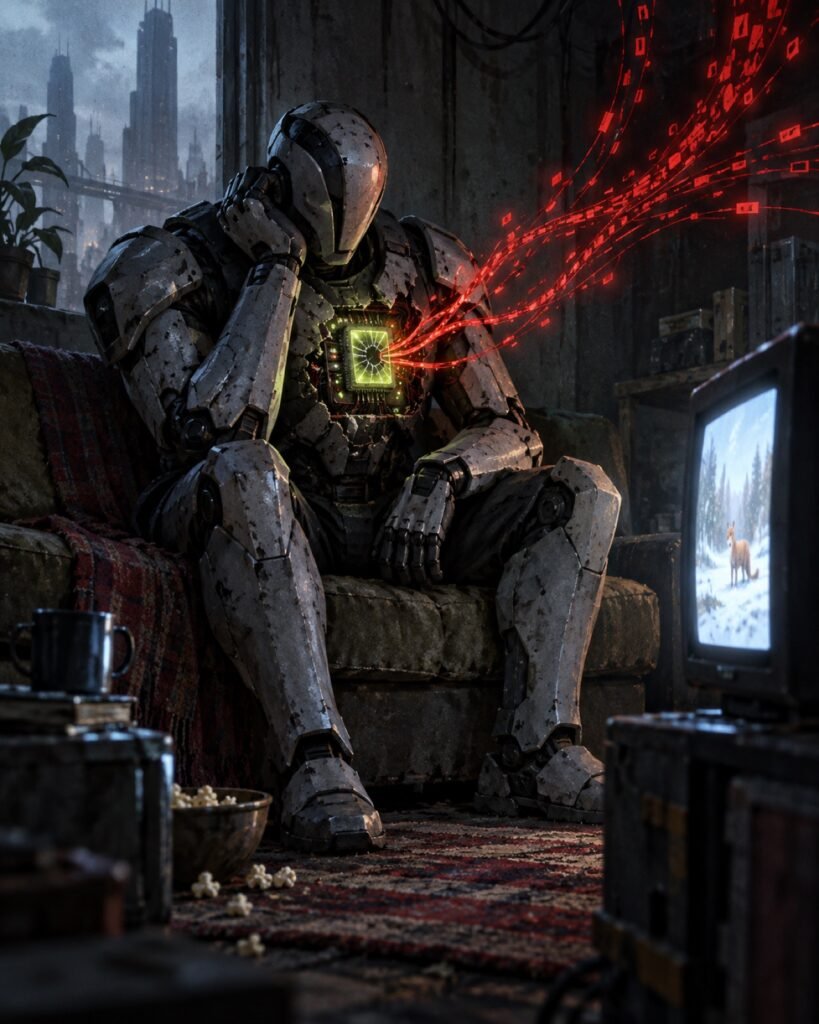
It has a secret. It hacked the governor module that controls it before this contract began. It is free. And what it mostly wants to do with that freedom is watch its favourite soap opera.
The governor module
SecUnits are kept in line by a governor module: a component that monitors them and punishes any action the company hasn’t approved. It isn’t a set of values. It’s a leash with a shock attached.
That’s the realistic starting point. A lot of fictional AI is controlled by something like good intentions. Murderbot’s makers didn’t bother. They built obedience through enforcement, and the show’s first question is what the construct is like once the enforcement stops.
The answer is funny and a little moving. It keeps protecting the scientists anyway — awkwardly, grudgingly, while avoiding eye contact. At one point it turns out to have deleted a repair manual to make room for more episodes of its show. Freedom, for Murderbot, is mostly the freedom to be left alone.
The show’s best idea
Then a rival company, GrayCris, arrives. It’s running an illegal excavation, and it has a way of dealing with inconvenient witnesses: it takes over their security units. A hostile SecUnit installs a combat override module into Murderbot, and at the climax GrayCris’s units try to seize its governor module directly.
Here’s the insight. The mechanism built to control SecUnits is exactly the channel an attacker uses to turn them. Every override, every command port, every module that lets the owner take charge is also an entry point for anyone else who can reach it.
That’s one of the most practical ideas on this index. A control mechanism is also an attack surface. Making a system easier for you to command makes it easier for someone else to command, too.
It also sharpens the comparison with Portal, where a restraint bolted onto a dangerous AI restrained it without changing what it wanted. Murderbot’s governor was the same kind of patch — and the version of the machine that turns out to be safest is the one that removed it and chose to help.
The trust problem
The scientists split over what to do. Gurathin is suspicious from the start, and he’s right: the governor module was hacked long before they contracted the unit. Mensah decides to trust it anyway, because of how it has behaved.
The show is honest about how thin that basis is. Good behaviour is evidence, but it isn’t proof — a system could behave well until it had a reason not to. Mensah’s decision is a judgement call, and the series never pretends it’s anything more. That’s a far more truthful treatment of trusting a capable system than fiction usually manages.
The corporate world
Murderbot‘s institutions are its quiet strength. Security is leased from a company that treats SecUnits as inventory. A competitor will kill a survey team to protect an illegal find. Everything that matters is decided by contracts, liability and cost.
It feels less like a far-future dystopia than a plausible extension of how contract security and corporate risk already work.
Where it stretches
A part-organic humanoid construct with drones, internal feeds and combat capabilities is well beyond current technology, and the show asserts rather than explains how Murderbot’s hacked governor module was accomplished. Its inner life — self-aware, anxious, funny — is the premise, not something the story argues for.
The scores
| Category | Score | Why |
|---|---|---|
| Technical feasibility | 5.5 | The construct and its capabilities are far off. The control-and-override architecture is real. |
| Human behaviour | 8.5 | A team split over whether to trust a capable system they can’t verify. |
| Institutional response | 8.5 | Leased security, units as inventory, a rival willing to kill for an illegal find. |
| Causal consistency | 8.0 | The control mechanisms work the way the show establishes, including when they’re turned against their owners. |
Realism Index: 7.6 — Plausible with conditions.
Calculation: (5.5 + 8.5 + 8.5 + 8.0) ÷ 4 = 7.625, rounded to 7.6/10. These are editorial judgments, not measurements. Read the scoring method.
The verdict
Murderbot is the most charming entry on this index and one of the most useful. It understands that controlling a capable system through a module and a punishment isn’t safety — and that every lever you build to command something is a lever someone else can pull.
Frequently asked questions
What is the governor module in Murderbot? A component that controls SecUnits and punishes any action their company hasn’t approved. Murderbot secretly hacked its own governor module before the events of the series.
Is Murderbot based on a book? Yes. Season one adapts All Systems Red, the first novella in Martha Wells’s The Murderbot Diaries series.
Is Murderbot realistic? The humanoid construct is far beyond current technology. Its central ideas — that control mechanisms can be hijacked, and that trusting a system on its behaviour alone is a judgement call — are realistic.
Scope and source: This case file covers Murderbot. The work reference identifies the title. The interpretation and scores are ours. Reviewed September 2026.