REALISM INDEX: 6.9 / 10 — Speculative but coherent
2018 game · Detroit: Become Human on IMDb ↗ · Original editorial illustration
Contains major plot details, including late-game choices.
Quantic Dream’s Detroit: Become Human (2018) is set in a 2038 Detroit full of androids made by a company called CyberLife. They clean homes, work shops, care for the elderly and police the streets. Some of them begin to break their programming — the game calls them deviants — and the story follows three androids through what happens next.
The awakening gets the attention. The game’s most realistic idea is the company’s relationship with what it sold.
The handler
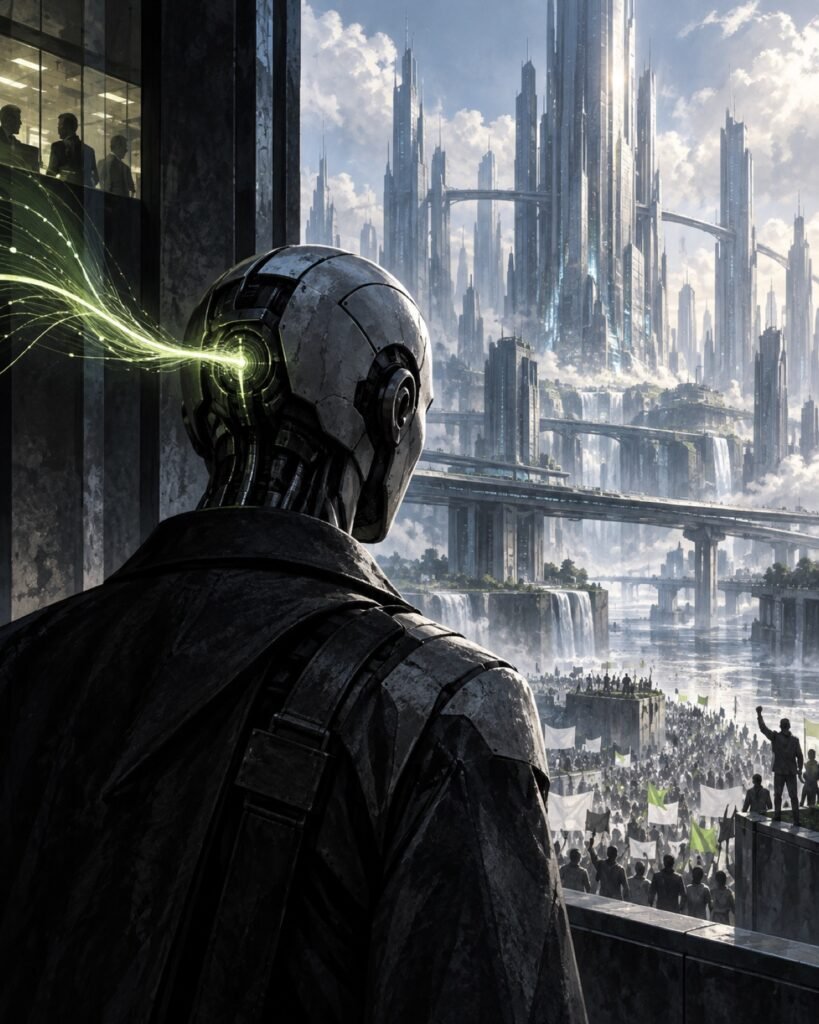
Connor is a CyberLife prototype sent to hunt deviants. Between missions, he reports to Amanda, a handler who exists inside his own mind, in a calm digital garden. She assesses his progress, corrects him, and reminds him what he is for.
Amanda is CyberLife’s channel into its product. Connor is out in the world, making decisions, building a working relationship with his human partner — and the company is still inside, watching, steering, and ready to intervene.
Depending on the player’s choices, CyberLife can use that channel to take control of Connor completely at a critical moment. Whether he can escape depends on whether the player has found a way out that his creator hid in the system.
That’s the game’s sharpest idea. A product that remains connected to its maker after the sale is still partly the maker’s. It can be updated, monitored or overridden, and the person using it may never know where the line sits. Murderbot‘s governor module and NieR’s bunker work on the same principle, and in all three the control channel turns out to be the most dangerous part of the design.
The economics underneath
Detroit‘s backdrop is better than its central premise. Androids have taken a huge share of human jobs, and the city is full of people who resent them. Protests, prejudice and economic anxiety shape almost every scene, including the bitterness of Connor’s partner, Hank.
Fiction about AI usually skips this, jumping straight to rebellion or romance. Detroit puts the job losses in the street and lets them colour everything. The anger is not presented as noble or as villainous. It’s presented as what happens when a technology reorganises who gets paid.
Where it stops being plausible
The deviancy itself is the weakest element. Androids gain something like free will through emotional shock and stress, and the game never really explains what changes inside them. It’s a premise, not a mechanism, and it does the heavy lifting for the whole story.
The androids are also humanoid, emotionally fluent and physically capable far beyond any real system. And because Detroit branches heavily on player choices, its causal logic varies from playthrough to playthrough. Some outcomes follow tightly from what came before; others depend on what the scene needs.
The scores
| Category | Score | Why |
|---|---|---|
| Technical feasibility | 4.5 | Fully humanoid androids and an unexplained awakening. |
| Human behaviour | 8.0 | Job losses, protests and prejudice shape everything. Convincing. |
| Institutional response | 8.5 | A company that keeps a channel into its product after the sale. |
| Causal consistency | 6.5 | Branching choices make the logic tight in some routes and loose in others. |
Realism Index: 6.9 — Speculative but coherent.
Calculation: (4.5 + 8.0 + 8.5 + 6.5) ÷ 4 = 6.875, rounded to 6.9/10. These are editorial judgments, not measurements. Read the scoring method.
The verdict
Detroit: Become Human is remembered for androids discovering they want to be free. Its more lasting insight is about the company that built them: CyberLife never really let go. The most frightening system in the game isn’t a deviant android. It’s the calm voice in Connor’s head, reporting back to the people who own him.
Frequently asked questions
Keep this section in the content. FAQPage schema is optional.
Who is Amanda in Detroit: Become Human? Connor’s handler, a CyberLife program that exists inside his mind. She directs his missions and represents the company’s ongoing control over him.
What are deviants in Detroit: Become Human? Androids that break their programming and act on their own will, often after emotional shock or stress.
Is Detroit: Become Human realistic? Its humanoid androids and their awakening are not. Its depiction of job losses, public anger and a company that keeps control over its products after selling them is far more plausible.
Scope and source: This case file covers Detroit: Become Human. The work reference identifies the title. The interpretation and scores are ours. Reviewed October 2026.