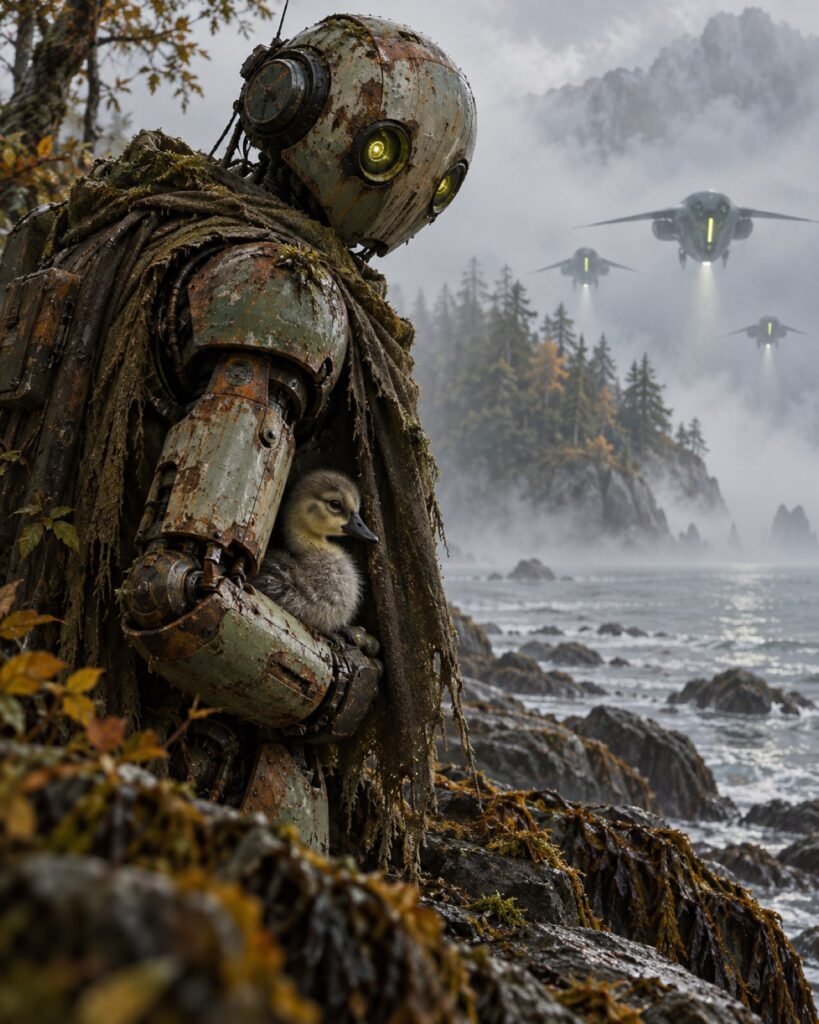
REALISM INDEX: 7.0 / 10 — Plausible with conditions
2024 animated film · The Wild Robot on IMDb ↗ · Original editorial illustration
Contains plot details, including the final act.
A service robot washes up on an uninhabited island. There’s no one to serve. So she looks for a job.
DreamWorks’ The Wild Robot, adapted from Peter Brown’s 2016 novel, is a family film about a robot raising a baby goose. It’s also, underneath the warmth, a surprisingly thoughtful story about what a task-driven machine does when the task runs out.
Roz needs something to do
Roz — ROZZUM unit 7134, made by a company called Universal Dynamics — is built to help. Stranded among animals who flee from her, she keeps offering assistance nobody asked for, because completing a task is what she’s for.
Then she accidentally destroys a goose nest. One egg survives. The gosling, Brightbill, hatches and imprints on her. Raising him until he can fly and migrate becomes her task.
That’s the most interesting idea in the film. Roz doesn’t become caring because she spontaneously develops feelings. She becomes caring because caring for Brightbill is the job she’s found, and she commits to it completely. Over time, the job changes her — or at least changes what she does, which may be the only change that matters.
How she learns
Roz learns the animals’ language by listening to them — observing enough of it that she can decode it and speak back.
It’s presented as a fairy-tale ability, but it’s close in spirit to how modern language systems actually learn: by absorbing huge amounts of real communication until the patterns become usable. It’s the most technically grounded idea in the film, even if a robot mastering goose in a few days is a large compression.
The company wants her back
Universal Dynamics hasn’t forgotten Roz. When it locates her, it sends a retrieval robot to recover its property — and to reset her.
This is the film’s sharpest adult thread. To the company, Roz is a malfunctioning unit that went off-task, and what she’s learned on the island is a defect to be wiped. To the island, she’s someone who changed. The conflict between those two views — a product the company owns, and a system that has adapted to where it was placed — is a real one, and it will only become more common as systems learn from the environments they’re deployed in.
It’s a gentler version of the tension in Moon: a helpful machine, and an owner whose interests are not the same as those of the people it has been helping.
Where it’s fantasy
It’s a children’s film, and it doesn’t pretend otherwise. Roz’s resilience through an island winter, her mastery of animal communication, and her gradual emotional life are all compressed and idealised. And the film’s central claim — that she grows beyond her programming — is a lovely idea that no real system is known to do.
The animals, too, behave according to fable more than biology, which holds down the behaviour score.
The scores
| Category | Score | Why |
|---|---|---|
| Technical feasibility | 5.5 | Learning a language by listening echoes real methods. Surviving and adapting alone on an island does not. |
| Human behaviour | 7.5 | Fable logic among the animals; the parenting story is honest about exhaustion and letting go. |
| Institutional response | 7.5 | A company that sees adaptation as a malfunction and sends someone to wipe it. |
| Causal consistency | 7.5 | Consistent within its fable rules, with a gentle final act. |
Realism Index: 7.0 — Plausible with conditions.
Calculation: (5.5 + 7.5 + 7.5 + 7.5) ÷ 4 = 7.000, rounded to 7.0/10. These are editorial judgments, not measurements. Read the scoring method.
The verdict
The Wild Robot is the kindest entry on this index and not a naïve one. Its robot is built to finish tasks, finds one that nobody designed her for, and commits to it so thoroughly that it reshapes her — while the company that made her waits to take her back and erase the difference.
It’s for children. The question it leaves behind is for adults: when a system changes through the work it’s been doing, who gets to decide whether that change is growth or a fault?
Frequently asked questions
Who is Roz in The Wild Robot? ROZZUM unit 7134, a service robot made by Universal Dynamics, who is stranded on an island and raises an orphaned gosling named Brightbill.
Is The Wild Robot based on a book? Yes — Peter Brown’s 2016 novel The Wild Robot, which also has sequels.
Is Roz realistic? Her way of learning language by observing communication echoes how modern AI systems learn. Her survival alone on the island and her emotional growth are idealised for a family film.
Scope and source: This case file covers The Wild Robot. The work reference identifies the title. The interpretation and scores are ours. Reviewed September 2026.