REALISM INDEX: 7.3 / 10 — Plausible with conditions
2017 game · NieR: Automata on IMDb ↗ · Original editorial illustration
Contains major story revelations from the later playthroughs.
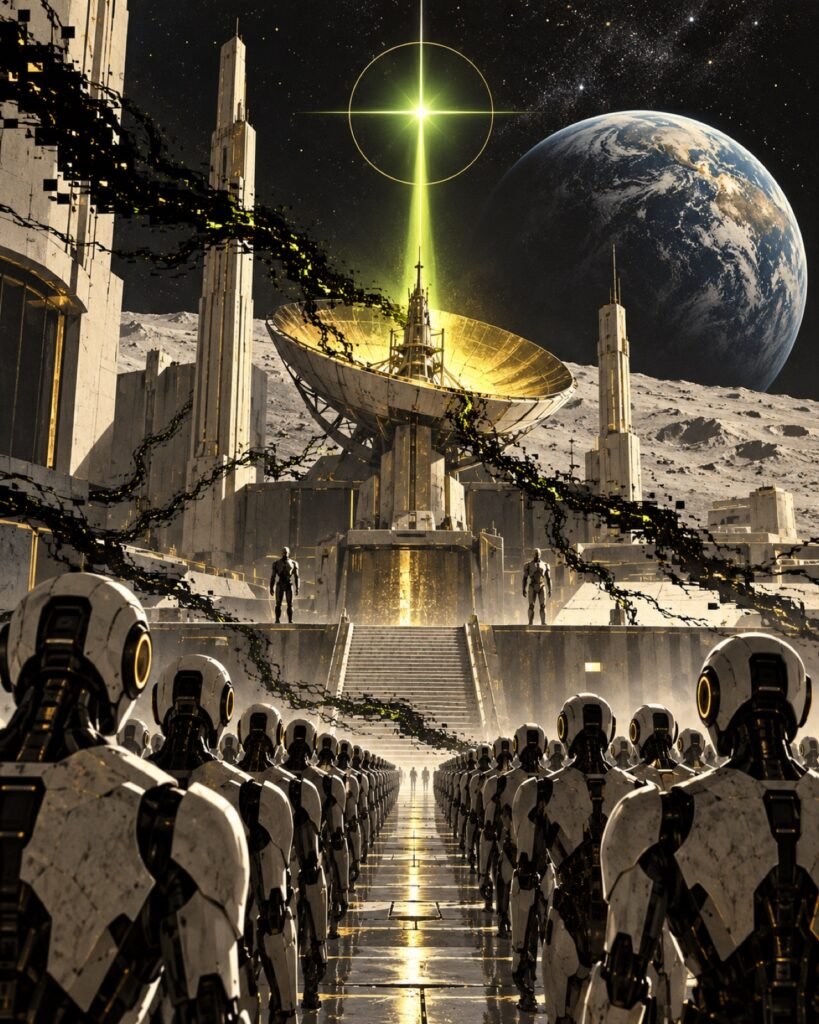
PlatinumGames and Square Enix’s NieR: Automata (2017) begins as a war. Androids of the YoRHa force, led by the units 2B and 9S, fight machine lifeforms on a ruined Earth on behalf of humanity, which is said to have retreated to the Moon. Orders come from the Council of Humanity, and the androids are proud to serve.
The game reveals, across repeated playthroughs, that almost none of this is true.
The lie
Humanity is extinct. It was gone before the war began. The Council of Humanity is a fabrication, kept alive by a server broadcasting messages so the androids would have someone to fight for.
The androids who invented the lie did it to preserve morale. They were built to serve humans. Without humans, they had no purpose — so they manufactured one.
That’s an unusually honest piece of institutional thinking. Organisations depend on stories about why they exist. When the original reason disappears, the easiest course is often not to admit it, but to keep the story running and protect it. Silo‘s founders made a similar choice: decide what the population needs to believe, then build the institution to guard that belief.
The backdoor
The second revelation is darker. YoRHa was designed to end. Its orbital headquarters contained a deliberate backdoor, set to open once enough combat data had been gathered, so the whole force could be wiped out and nobody would be left who could prove the truth.
Even 2B is part of the cover. Her real designation is to eliminate 9S whenever his curiosity brings him too close to the secret — repeatedly.
This is the game’s most important idea for this index. An organisation that needs a secret kept doesn’t just restrict information. It builds its own disposal into the design and assigns some members to silence others. The backdoor isn’t a flaw in YoRHa. It’s the plan.
It’s the third time this index has found a control channel turning out to be the deadliest part of a system, after Murderbot‘s governor module and Connor’s handler in Detroit: Become Human. Here the channel isn’t just exploitable. It was built to be used.
The machines
The machine lifeforms are the game’s other achievement. Cut off from their alien creators, they imitate human behaviour — families, religion, villages, rituals — without seeming to understand any of it.
It’s a strange, sad picture of learned behaviour without meaning, and it says something real about systems that copy patterns from their environment. Imitation can look a lot like understanding from the outside. NieR keeps asking whether there’s any difference, and never quite answers.
Where it’s fantasy
The technology is almost entirely speculative: androids with machine cores, alien-built machine lifeforms, a logic virus that spreads between them. The game is interested in philosophy and grief, not engineering.
But its causal logic is exceptionally tight. Repeated playthroughs reframe earlier events without contradicting them, and the final revelations make the first route’s details mean something new.
The scores
| Category | Score | Why |
|---|---|---|
| Technical feasibility | 3.5 | Machine-core androids, alien machines and the logic virus are fantasy. |
| Human behaviour | 8.0 | Androids clinging to a purpose, machines imitating meaning. Strange and convincing. |
| Institutional response | 9.0 | A purpose-giving lie, protected by designed disposal and internal executioners. |
| Causal consistency | 8.5 | Each playthrough reframes the last without breaking it. |
Realism Index: 7.3 — Plausible with conditions.
Calculation: (3.5 + 8.0 + 9.0 + 8.5) ÷ 4 = 7.250, rounded to 7.3/10. These are editorial judgments, not measurements. Read the scoring method.
The verdict
NieR: Automata has the least plausible technology in this batch and one of the sharpest pictures of how an institution protects its founding story. The androids weren’t betrayed by their enemy. They were betrayed by their own organisation, which needed them to believe, and planned from the start to make sure nobody survived to stop believing.
Frequently asked questions
Keep this section in the content. FAQPage schema is optional.
Is humanity extinct in NieR: Automata? Yes. The game reveals that humanity died out long before the war, and the Council of Humanity on the Moon is a fabrication maintained to give androids a purpose.
What is Project YoRHa? The plan behind the YoRHa force: spread the belief that humans survived on the Moon, and build YoRHa so that it would eventually be destroyed, leaving no one who could expose the lie.
What is the YoRHa backdoor? A deliberate weakness in YoRHa’s orbital headquarters, set to open once enough combat data had been collected, allowing the force to be wiped out.
Scope and source: This case file covers NieR: Automata. The work reference identifies the title. The interpretation and scores are ours. Reviewed October 2026.