REALISM INDEX: 6.5 / 10 — Speculative but coherent
2026 film · Mercy on IMDb ↗ · Original editorial illustration
Contains the film’s twist and ending.
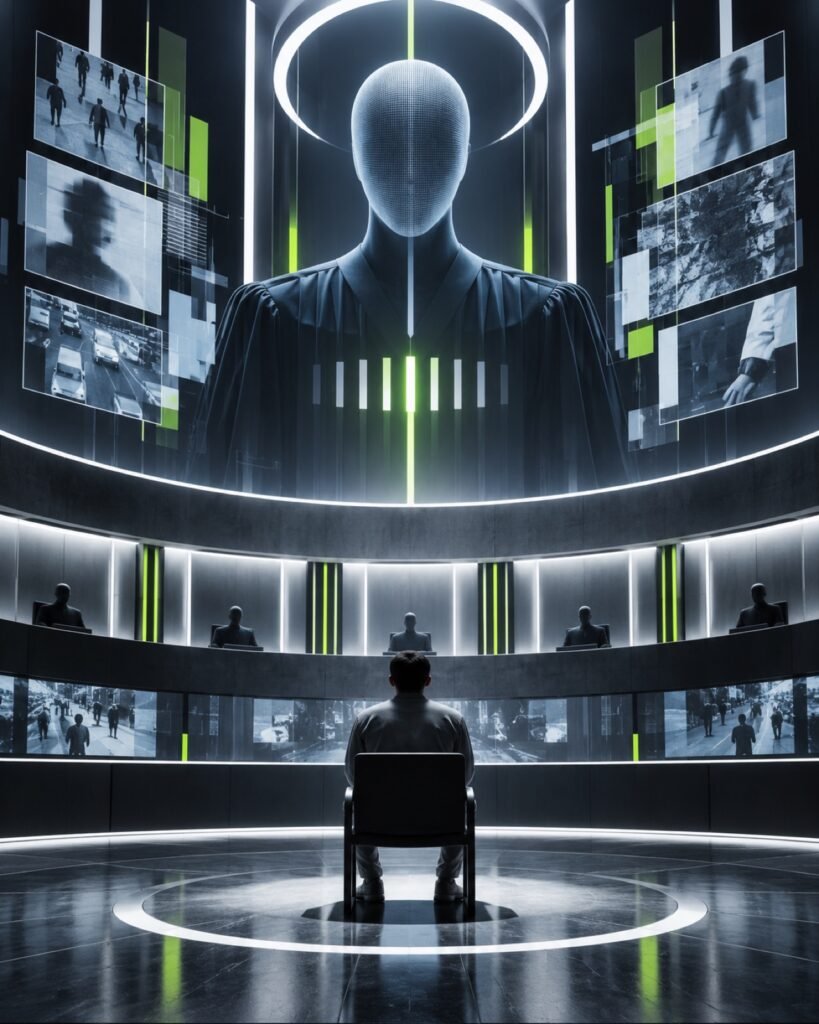
In Timur Bekmambetov’s Mercy, released in January 2026, Los Angeles has answered a surge in violent crime with AI judges. Every registered device feeds a municipal cloud. A defendant is strapped into a chair and given 90 minutes to bring their probability of guilt below the threshold. Fail, and the sentence is carried out.
The defendant this time is Chris Raven, the detective who campaigned for the system. The judge is Maddox, played by Rebecca Ferguson as a calm, attentive presence on a screen.
Critics were not kind to the film. But its central failure is one of the most realistic ideas in any AI story this year.
The number
Raven starts at 97.5% probable guilt and needs to get below 92%. The film builds its suspense on that meter.
It’s a sharp image of a real temptation: reducing a judgement to a single number with a fixed line. A probability sounds precise and neutral. It is neither. It depends entirely on what evidence the system has, how that evidence was weighted, and who decided where the line goes. A defendant at 91.9% and one at 92.1% are not meaningfully different people, but one of them lives.
Risk-scoring tools already inform some real decisions about bail and sentencing, and the arguments about them are the same ones the film dramatises: false precision, unexamined inputs, and a number that makes a human decision feel like an objective one.
What went wrong the first time
The twist is where Mercy earns its score. The very first person the court executed was innocent. The system didn’t malfunction. Evidence that would have cleared him was withheld by a police officer — and she hid it to protect the programme’s success.
This is exactly how automated judgement fails in practice. The system can only weigh what it receives. If a human filters the inputs, the output inherits the filter, and it arrives looking impartial. The machine becomes a way of laundering a human choice into an objective-seeming result.
It’s the same diagnosis this index keeps reaching. Psycho-Pass‘s Sibyl System turned out to have people inside it. The Creator blamed a machine for a human error. Mercy‘s version is quieter and closer to home: one person, protecting an institution she believed in, deciding what the system was allowed to see.
The judge who investigates
Maddox isn’t only a judge. She searches footage, pulls messages, contacts witnesses and follows leads, all within the trial. Raven is acquitted largely because he knows how to direct her.
That’s the film’s other real insight, even if it doesn’t linger on it. A system that is judge, investigator and prosecutor at once concentrates every role our courts deliberately keep apart. And a defendant who knows how to steer it — a detective, say — gets a very different trial from one who doesn’t. Access to the machine becomes access to justice.
Where it stops being plausible
A city executing people after 90-minute trials run by software, with the burden on the defendant to prove innocence, would not survive contact with any modern legal system. The premise needs you to accept it, and the film spends almost no time on how it was allowed to happen.
The action plot — a bomb, a truck, a chase toward the courthouse — is driven by thriller convenience. Maddox’s capabilities expand to whatever each scene requires, including reaching out into the physical world at the climax.
The scores
| Category | Score | Why |
|---|---|---|
| Technical feasibility | 6.5 | Integrating surveillance and device data is plausible. Instant, total retrieval of any evidence is not. |
| Human behaviour | 6.5 | The officer protecting the system is convincing; much else runs on thriller logic. |
| Institutional response | 7.0 | Crime panic driving adoption, and a human filtering inputs: sharp. The legal premise itself is not credible. |
| Causal consistency | 6.0 | Maddox’s reach grows to fit the climax. |
Realism Index: 6.5 — Speculative but coherent.
Calculation: (6.5 + 6.5 + 7.0 + 6.0) ÷ 4 = 6.500, rounded to 6.5/10. These are editorial judgments, not measurements. Read the scoring method.
The verdict
Mercy is a noisy thriller with one quiet, true idea: an automated verdict is only as sound as the evidence it’s allowed to see, and the people with the most interest in the system’s success are also the people best placed to decide what that is.
The AI judge will never exist in this form. The officer who hid the evidence already does.
Frequently asked questions
What is the Mercy Court in Mercy (2026)? A system in the film’s 2029 Los Angeles in which AI judges try defendants for violent crimes, using data from registered devices. Defendants have 90 minutes to reduce their probability of guilt below a set threshold.
Who is Judge Maddox? The AI judge presiding over Chris Raven’s trial, played by Rebecca Ferguson. She searches evidence and investigates during the trial itself.
Could an AI judge like Mercy happen? Not in this form — the trials, executions and reversed burden of proof would be incompatible with modern legal systems. The film’s underlying concern, that automated judgements depend on inputs humans can filter, is realistic.
Scope and source: This case file covers Mercy. The work reference identifies the title. The interpretation and scores are ours. Reviewed September 2026.