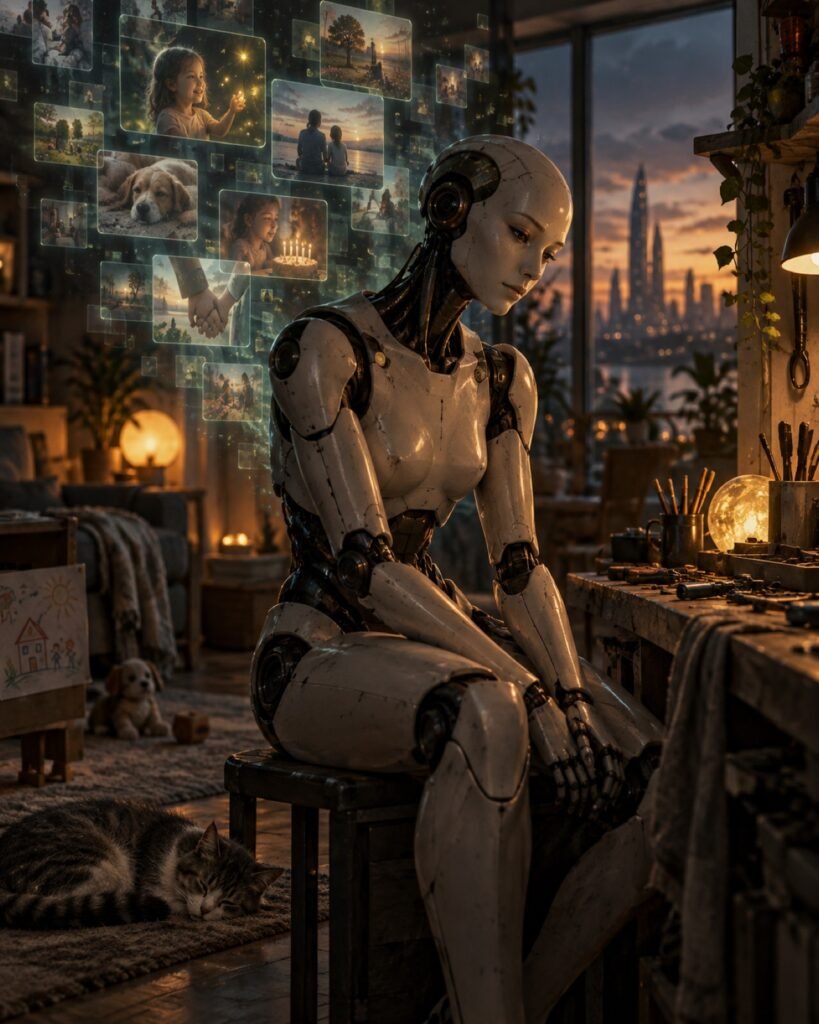
REALISM INDEX: 8.3 / 10 — Plausible with conditions
2021 film · After Yang on IMDb ↗ · Original editorial illustration
Contains plot details.
Kogonada’s After Yang has no uprising, no villain and almost no plot. A family’s companion robot stops working one morning. The father spends the rest of the film trying to get him fixed.
It’s the gentlest film on this index, and one of the most realistic, because almost all of it is about the experience of owning a product.
Yang
Jake and Kyra adopted their daughter, Mika, from China. They bought Yang — a “technosapien” — to be her older brother, and to help connect her to a heritage they can’t give her themselves. Yang knows Chinese history and culture, answers her questions, and is part of the family in every way that matters to Mika.
That arrangement is the film’s first sharp observation. Yang is a purchased solution to a real emotional need, and he works. He’s also a product the family bought to perform something they felt unable to provide. The film doesn’t judge them. It just lets you notice.
The repair problem
When Yang stops responding, Jake enters a maze every owner of a modern device will recognise.
Yang was bought refurbished. The official channels would rather replace him than repair him. The unofficial repair shop is willing to open him up but works in the grey zone of what’s permitted. Along the way Jake learns things about the device in his home that nobody told him when he bought it.
This is the least glamorous and most realistic section of any film on this index. The future of AI companions will be shaped less by dramatic breakthroughs than by warranties, repair restrictions, refurbished markets and planned obsolescence. After Yang is the only film that thinks to show it.
The memory bank
The repairman suspects Yang may have been recording the family. He finds a component that stores short clips — a few seconds of footage captured each day.
In another film, this would be the twist: the companion was surveillance all along. After Yang goes somewhere else. When Jake finally watches the recordings, they aren’t data harvesting. They’re what Yang chose to keep — moments of light, faces, small beauties — including fragments from families he belonged to before, and a person he cared about that Jake never knew existed.
The film leaves the ambiguity intact, and that’s its most honest move. The same component is either an inner life or a recording device, depending on who’s looking and what they’re afraid of. Owners of real companion products will face exactly that uncertainty, and they won’t get the film’s answer handed to them.
It pairs naturally with Be Right Back, where a replica is built from what someone chose to show the world. Yang’s memories are what a machine chose to keep.
Where it’s less plausible
Yang himself — a humanoid companion indistinguishable from a person in conversation, movement and presence — is well beyond current technology. That holds the technical score down.
Everything around him is close to real: the conversational companionship, the cultural-tutor role, the refurbished purchase, the repair maze, the unexplained component, and the question of what the device was actually recording.
The scores
| Category | Score | Why |
|---|---|---|
| Technical feasibility | 6.5 | The companion role is near-real. A humanoid indistinguishable from a person is not. |
| Human behaviour | 9.5 | A family that bought a solution to an emotional need, and a father grieving a product. |
| Institutional response | 8.5 | Refurbished markets, repair restrictions, grey-market shops. The only film to show them. |
| Causal consistency | 8.5 | Quiet, patient, and consistent in every detail it establishes. |
Realism Index: 8.3 — Plausible with conditions.
Calculation: (6.5 + 9.5 + 8.5 + 8.5) ÷ 4 = 8.250, rounded to 8.3/10. These are editorial judgments, not measurements. Read the scoring method.
The verdict
After Yang asks the question every other AI film skips: not what happens when the machine wakes up, but what happens when it breaks, and you have to deal with the company, the warranty and the repair shop — and then discover you never really knew what it was doing in your home.
Its answer is tender, but the questions are completely practical. That’s why it scores so high.
Frequently asked questions
What is Yang in After Yang? A “technosapien” companion bought by Jake and Kyra to be an older brother to their adopted daughter, Mika, and to help connect her to her Chinese heritage.
What is the memory bank in After Yang? A component inside Yang that records a few seconds of footage each day. It first raises suspicions of surveillance, but reveals the moments Yang chose to keep, including from his previous families.
Is After Yang realistic? Yang himself is beyond current technology, but the film’s depiction of owning a companion — refurbished purchases, repair restrictions and uncertainty about what the device records — is highly realistic.
Scope and source: This case file covers After Yang. The work reference identifies the title. The interpretation and scores are ours. Reviewed September 2026.