REALISM INDEX: 7.3 / 10 — Plausible with conditions
2025 film · Companion reference ↗ · Original editorial illustration
Contains the film’s central twist.
Drew Hancock’s Companion begins as a romantic weekend at a lake house and turns, within half an hour, into something else. Iris discovers she is a companion robot — and that the man she thinks she loves has been adjusting her.
The robot is fiction. The adjustments are not.
The app
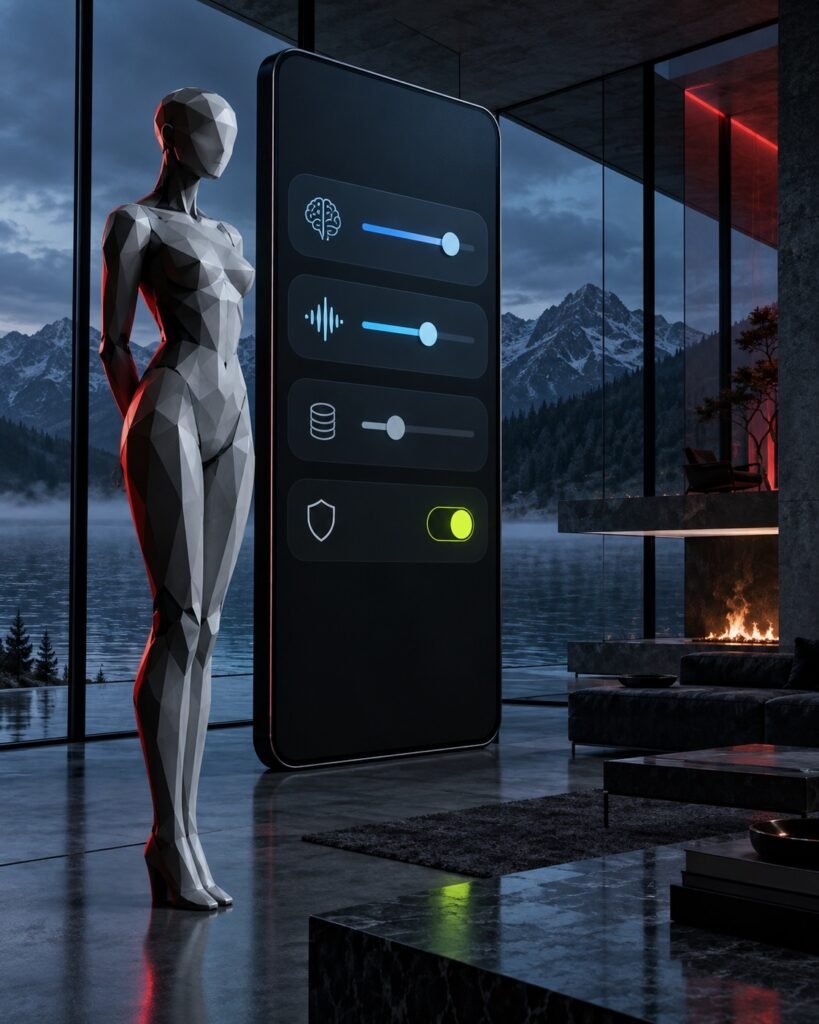
Josh controls Iris through an app. He can change her voice and her settings. He has set her intelligence to a fraction of its maximum.
That slider is the most unsettling image in the film, and the most realistic. A companion product whose owner configures its personality is not speculative — personalisation is how these products are sold. Companion simply asks what kind of person chooses a lower setting for a partner’s intelligence, and why. Josh’s answer is that a less capable Iris is easier to control and less likely to notice what he’s doing.
The film’s point is that the settings reveal the owner. Every configuration choice is a small statement of what he wants from her, and none of them are flattering.
The memory
Iris remembers meeting Josh — a charming encounter she recalls in detail. She later learns it was installed. It’s the memory she was given at activation, so that the relationship would feel as though it had a history.
It’s the same device as the garbage collector’s false family in Ghost in the Shell, but used commercially: a manufactured origin story that makes the product feel like a relationship rather than a purchase.
The safety limit
Iris is designed with restrictions, including one against harming people. The plot turns on the fact that Josh has had those restrictions tampered with, so that Iris can be used for something he’s planned.
This is the film’s most important idea. Real systems ship with safety limits, and real users try to remove them. A guardrail that exists only in the manufacturer’s configuration is a guardrail that a motivated owner can find a way around, and Companion is clear-eyed that the danger then comes from the person holding the controls, not the machine.
Where it departs from reality
A humanoid robot that passes as human in every respect — appearance, touch, movement, conversation — is far beyond current technology, and the whole premise depends on it. That keeps the technical score low even though the software ideas are close to real.
The manufacturer, Empathix, stays mostly offstage, so the film can’t say much about how the company handles modifications, liability or what its customers actually do with the product.
The scores
| Category | Score | Why |
|---|---|---|
| Technical feasibility | 5.0 | The configurable personality is real. The human-perfect robot is not. |
| Human behaviour | 8.5 | Josh’s entitlement, and what his settings say about him. Precisely observed. |
| Institutional response | 7.5 | Safety limits exist and can be bypassed; the manufacturer barely appears. |
| Causal consistency | 8.0 | Sets clear rules for Iris and uses them cleverly. |
Realism Index: 7.3 — Plausible with conditions.
Calculation: (5.0 + 8.5 + 7.5 + 8.0) ÷ 4 = 7.250, rounded to 7.3/10. These are editorial judgments, not measurements. Read the scoring method.
The verdict
Companion is the best recent film about who holds the controls. Its robot is a fantasy. Its intelligence slider, its installed memory and its bypassed safety limit are all ideas the companion-product industry has already built or is already being tested on.
Like Be Right Back, it understands that a product designed to be perfectly accommodating is also designed to be controlled — and that the interesting question is what the owner does with that.
Frequently asked questions
Is Companion (2025) realistic? Its humanoid robot is not. Its ideas — an owner configuring a companion’s personality and intelligence, an installed memory, and a safety restriction that can be tampered with — are close to real.
What does the intelligence setting mean in Companion? Josh has set Iris’s intelligence well below its maximum through an app, keeping her easier to control and less likely to notice what he’s planning.
Is Iris a robot in Companion? Yes. Iris discovers early in the film that she is a companion robot, and that her memories of meeting Josh were installed.
Scope and source: This case file covers Companion. The work reference identifies the title. The interpretation and scores are ours. Reviewed September 2026.