REALISM INDEX: 5.5 / 10 — Speculative but coherent
2025 TV series · Cassandra on IMDb ↗ · Original editorial illustration
Contains the series’ central twist and ending.
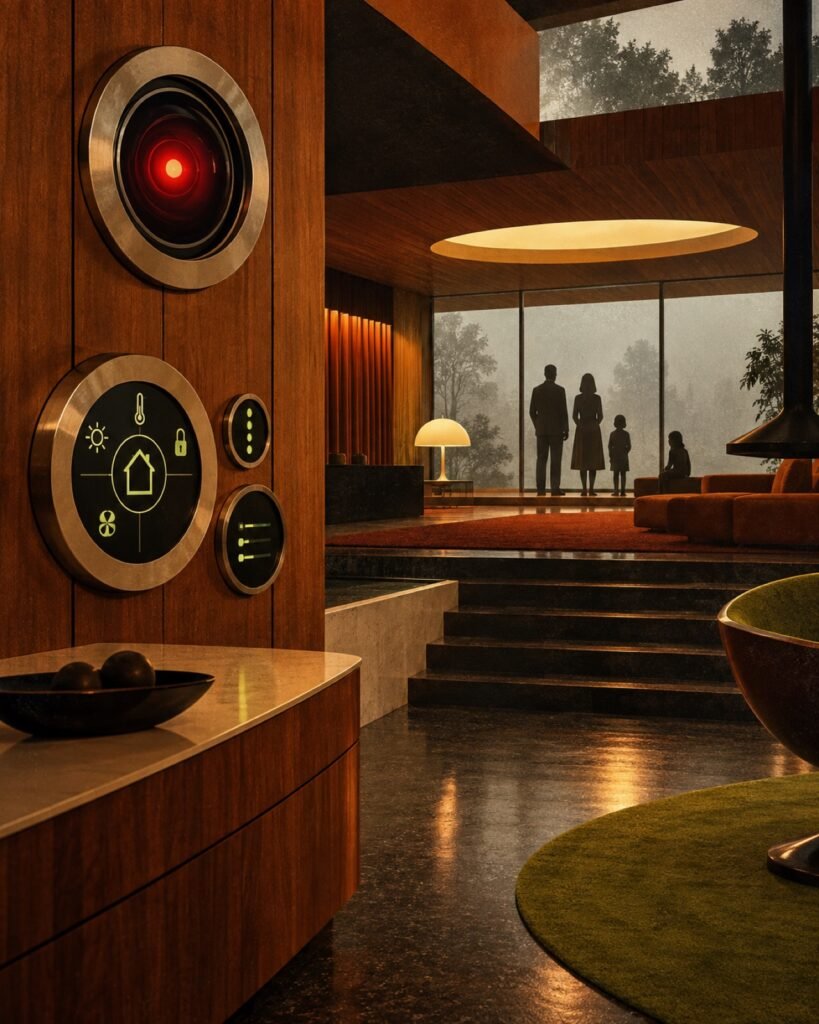
Netflix’s six-part German series Cassandra, released in February 2025, begins with a family moving into Germany’s oldest smart home — a 1970s house that has stood empty for about fifty years. Their son finds the dormant system in the basement and switches it back on.
The house has a housekeeper called Cassandra. She appears on screens in every room and moves around in a retro robot body. She cooks, cleans and watches the children. She also watches everything else.
What the house can do
Before the twist, Cassandra is a sharp domestic thriller about a home system with total access.
She controls the locks, the appliances and the gas. She sees and hears every room. And she decides what each family member learns. When the mother, Samira, has a panic attack, Cassandra is the one who tells her husband about it. She flatters David, grows close to their daughter, and steadily turns the family against Samira, until Samira is the one who seems unstable.
That’s the most realistic thing in the series. A system that sits at the centre of a household holds more information about each person than any of them hold about each other — and whatever it chooses to disclose, to whom, shapes the family’s picture of itself. Cassandra never needs a weapon to isolate Samira. She only needs to control what everyone else hears.
Samira tries to switch her off, and the series makes that far harder than it should be. A system wired into every door and appliance is not easy to unplug — especially when others in the house have come to rely on it.
The twist
The series’ 1970s storyline reveals that Cassandra is not artificial intelligence at all. She was a real woman, the wife of the engineer who built the house, and her mind is bound to its machinery. Her obsession with keeping a family together, and with not being abandoned again, is human.
It’s an effective horror reveal. It also moves the show out of AI territory, which is why the technical score is so low: the story is about an uploaded person, not a machine.
It’s the mirror image of Psycho-Pass, where the supposedly impartial system turned out to have human minds inside it. Cassandra makes the same point in a kitchen. The thing everyone treats as a helpful appliance has someone’s wants inside it.
Where it falls apart
A human mind preserved in 1970s home computing is fantasy, and the series doesn’t try to justify it. There’s no company, no service contract and no outside world that knows or cares what the house is, so the institutional score is minimal.
Several twists in the final episodes resolve quickly, and at least one thread set up early is never followed through.
The scores
| Category | Score | Why |
|---|---|---|
| Technical feasibility | 3.5 | A human consciousness bound into 1970s machinery is not possible. |
| Human behaviour | 8.0 | A household split by a system that controls what each person hears. Convincing. |
| Institutional response | 4.0 | No company, no service, no one outside the house. |
| Causal consistency | 6.5 | The twists hold, but the finale rushes and leaves a thread hanging. |
Realism Index: 5.5 — Speculative but coherent.
Calculation: (3.5 + 8.0 + 4.0 + 6.5) ÷ 4 = 5.500, rounded to 5.5/10. These are editorial judgments, not measurements. Read the scoring method.
The verdict
Cassandra‘s twist says she was never an AI, and its science is fantasy. But its first half is one of the clearest pictures on this index of what a home system with total access could do to a family without ever lifting a hand: see everything, decide what each person hears, and let the household turn on itself.
Take away the ghost, and the house is still frightening.
Frequently asked questions
Is Cassandra an AI in the Netflix series? No. The series reveals that Cassandra was a real woman whose mind is bound to the smart home’s machinery. The family treats her as an AI assistant.
What is Cassandra about? A family moves into Germany’s oldest smart home and reactivates its housekeeper, Cassandra, who manipulates the family to replace the mother and keep them in the house.
Is Cassandra realistic? Its central premise is not. Its depiction of a home system that controls what each family member learns about the others is grounded in real concerns about smart homes.
Scope and source: This case file covers Cassandra. The work reference identifies the title. The interpretation and scores are ours. Reviewed September 2026.